
HIPAA Essentials (Privacy + Security)
Core HIPAA training for healthcare teams covering privacy, security, minimum necessary, everyday safeguards, incident response, and the assessment required for certificate-backed completion.

Self-paced training for healthcare workers, business associates, and modern care teams. Complete the course, pass the assessment, download a publicly verifiable certificate the same day, and keep the record ready when an employer, manager, or audit file asks for proof later.
How it works
Start with HIPAA Essentials or choose the path that fits your workflow. Pricing, scope, and next steps stay clear before checkout.
Move through self-paced lessons, required mini quizzes, and practical HIPAA scenarios built around healthcare work instead of generic policy slides.
Finish the assessment, earn the certificate the same day you pass, and keep a public verification record employers and managers can check later.
Why USA HIPAA
Curriculum
Privacy, security, front-desk, billing, telehealth, and vendor scenarios are treated as daily operating decisions, not edge cases.
Delivery
The completion record is issued after the real course flow is complete, so buyers keep useful proof instead of a decorative badge.
Verification
The verification page can confirm the USA HIPAA certificate record without relying on a forwarded PDF alone.
Teams
Bulk pricing, invites, completion visibility, and scheduled refresh support make the team path operationally usable.
Modern risk
Home-office safeguards, cloud tools, shared devices, messaging, and telehealth workflows are part of the actual course path.
Renewal
One-year certificate terms, employer policy, and team visibility make future training easier to plan.
Training paths
Core HIPAA training for healthcare teams covering privacy, security, minimum necessary, everyday safeguards, incident response, and the assessment required for certificate-backed completion.
Short add-on HIPAA training for telehealth, remote work, mobile-device, cloud, messaging, and home-office workflows where PHI can move outside the clinic.
Role-specific HIPAA training for vendors and business associates covering BAAs, subcontractors, permitted uses, access discipline, security safeguards, client communication, and incident reporting.
A HIPAA certificate is useful because it shows that the learner completed a defined training path and assessment. That matters for onboarding, workforce files, annual refreshers, and employer review.
It does not mean an organization is automatically HIPAA compliant. Real compliance still requires policies, risk analysis, vendor oversight, access controls, incident response, and ongoing documentation.
Curriculum methodology
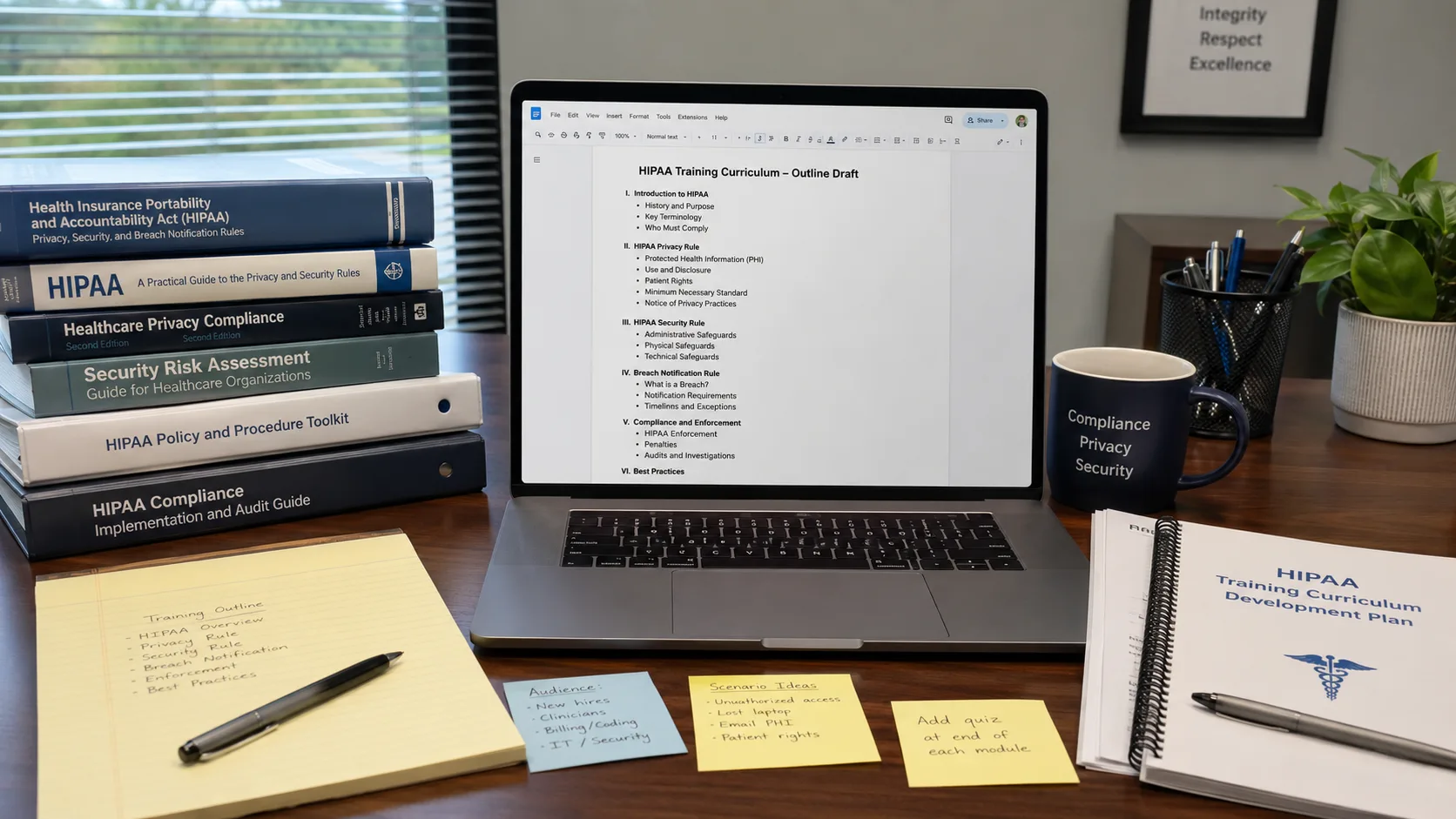
Course topics are organized around the HIPAA Privacy, Security, and Breach Notification Rules, with primary sources used for regulatory claims.

Modules pair explanations with role-based examples, required mini quizzes, and a final assessment so completion is tied to active learning.

A completed course produces a dated certificate and online verification record. Course claims should be reviewed when their governing sources change.
Behind the curriculum
Source-based explanations, scenario drafting, and assessment planning shape the modules learners complete.
The course is built around HIPAA workforce training expectations and the disclosure and security decisions staff make in real work.
Certificates are only issued after the learner completes the modules, clears the required mini quizzes, and passes the final assessment.
The USA HIPAA course record can be confirmed later through the verification page using its unique certificate code.
Training proves the learner completed a defined path. It does not replace policies, risk analysis, vendor oversight, or the rest of the compliance program.
If you are buying for a clinic, vendor, or distributed care team, you need more than one downloadable certificate. You need assignment control, completion visibility, renewal timing, and retrievable records when someone asks later.
FAQ
HIPAA Essentials has an estimated duration of about 90 minutes, including lesson video, mini quizzes, and the final assessment. Each course card shows its configured time estimate, and you do not need to complete a course in one sitting.
Yes. Individual buyers can create an account, enroll, and begin right away. Team buyers should start from the pricing or organizations path so seat planning and rollout stay cleaner.
No. The training is self-paced. Progress stays tied to your account so you can return to the modules before taking the final assessment.
USA HIPAA is built for employer review: the certificate names the learner, records the course and completion date, requires an 80% assessment score, and includes a code anyone can check on the public verifier. It is useful, inspectable proof of HIPAA training for hiring, onboarding, and workforce files. Acceptance policies can still vary by recipient.
You must complete every module, pass any required mini quizzes, and then pass the final assessment. The certificate is only issued after the course requirements are complete.
The final assessment is randomized from a larger question pool and requires an 80% passing score. That keeps the completion record tied to a real assessment instead of passive viewing alone.
Retakes are allowed, so you do not need to buy another attempt just to finish the course.
HIPAA Essentials starts at $39 for one learner. Team pricing begins at $29 per seat, drops to $24 at 10 seats, and reaches $18 per seat at 50 seats.
It records that a named learner completed the USA HIPAA course requirements and passed the assessment on a specific date. A receiving employer, school, or other reviewer decides whether that course record meets its requirements.
Each certificate includes a unique verification code. Employers or managers can confirm the record through the public verification page instead of relying on an emailed PDF alone.
Yes. The course includes remote communication, home-office safeguards, shared-device risk, vendor access, and telehealth realities that generic HIPAA training often skips.
Business associates subject to the Security Rule must implement a security awareness and training program under 45 CFR 164.308(a)(5). Contracts and employer policies may add role-specific requirements. A course certificate documents completion but does not by itself prove organizational compliance.
No. The training is designed for clinicians, front-desk teams, billing staff, managers, business associates, and other healthcare workers who touch protected health information in different ways.
Yes. If you are rolling this out across a practice or vendor team, use the team pricing and organizations paths so you can manage seats, completion visibility, and scheduled refreshes more cleanly.
USA HIPAA certificates carry a one-year term, but HIPAA does not set a universal annual deadline for private courses. Follow your employer's policy. For covered entities, the Privacy Rule also requires retraining when a material policy or procedure change affects a workforce member's work.
Contact customer support within 30 days to request a whole-Purchase refund review. A Purchase is no longer eligible once any learner has started training, and partial seat or Product refunds are not offered.
No. Training matters, but it does not replace policies, risk analysis, vendor oversight, access controls, incident response, and the rest of the compliance program.
HIPAA does not prescribe one universal refresh interval. Covered entities should follow the Privacy Rule's workforce training triggers, while covered entities and business associates subject to the Security Rule must maintain security awareness and training programs. Organizations should document any additional cadence set by employer policy.
Ready to start